
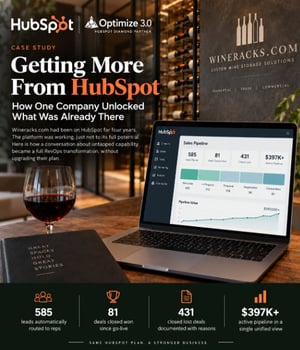
 Wineracks.com had been on HubSpot for four years. The platform was working, just not to its full potential. Here is how a conversation about untapped capability became a full CRM optimization.
The Starting Point
Wineracks.com designs and manufactures custom wine storage solutions, including wine cellars, glass enclosures, metal shelving, and wine rack systems, for residential buyers, interior designers, architects, and trade partners across North America. They are a established operation with a seasoned sales team, an active e-commerce presence, and a CEO who takes their technology seriously.
They had been on HubSpot since early 2022. By mid-2026, they had over 61,000 contacts in their portal and three dedicated sales reps. HubSpot was part of their daily workflow, but the CEO came to Optimize 3.0 with a straightforward observation: "HubSpot is a great CRM, but we are not getting enough from it."
That is one of the most common things we hear. And it is almost always true.
What They Were Looking For
The CEO had clear goals. He wanted leads to be followed up on consistently and quickly. He wanted visibility into his pipeline without having to ask his reps individually. And he wanted the system to do more of the heavy lifting, so his team could focus on selling rather than administrating.
HubSpot is built to do exactly those things. The opportunity was in unlocking the capabilities that were already available to them.
"The platform was capable of so much more. It just needed to be configured to reflect how the business actually works."
What the Audit Revealed
Before building anything, we conducted a full portal audit. What we found was a pattern common to SMBs that have grown into HubSpot organically over several years: plenty of activity, but without a unified structure to make sense of it.
No automatic lead routing
Form submissions from the website were arriving without automatic assignment. Leads were being manually distributed, inconsistently, or missed entirely. With three reps handling different types of inquiries, there was no system ensuring the right lead reached the right person at the right time.
Fragmented pipelines with no unified view
Each rep had built their own pipeline with their own stages and naming conventions. This is understandable; people naturally optimize for their own workflow. But it meant the CEO had no single view of the business. You cannot build management reporting or analyze pipeline health when every rep is working from a different map. With over 70 unique deal stage variants across the portal, meaningful analysis was effectively impossible.
No automated follow-up or SLA enforcement
Once a lead was assigned, nothing in the system ensured timely follow-up. No tasks were created automatically, no alerts fired, and there was no escalation path. For a company whose highest-intent leads represent significant potential revenue, this was a meaningful gap.
Limited management visibility
The CEO had no systematic way to see pipeline health, rep activity, or deal trends. The data existed in HubSpot. It just had not been configured to surface it in a useful way.
What We Built
The engagement covered six core areas, all built inside their existing HubSpot subscription.
Automated Lead Routing
We built two inbound routing workflows triggered by form submission. General inquiries route to the rep best positioned to handle them. Custom Design, Retail Design, and Design Consultation forms rotate in a round robin across the sales team. Every routed lead generates an automatic task and email notification for the assigned rep, with a clear one-hour response window. No manual assignment, no leads falling through.
SLA Enforcement and Escalation
If a new lead is not contacted within one hour, the CEO receives an automatic alert. At 21 days of inactivity on any deal, the rep and CEO are notified. At 28 days, the CEO receives a second escalation. The system now surfaces what is going quiet before it becomes a problem.
Closed Lost Automation
When a rep closes a deal as lost, they select a reason from a defined list. Based on that reason, a personalized follow-up email goes to the contact automatically at 14, 30, or 60 days depending on the loss reason. This gives reps the confidence to clean up their pipeline, knowing the system will handle re-engagement on their behalf.
Pipeline Standardization
We consolidated all pipelines into a single unified Sales Pipeline with agreed-upon stages, built around how the team actually works. New stages like Project on Hold and Waiting for Payment were added based on rep feedback, giving the team clear language for situations that previously had no formal home in the system.
Management Dashboards
For the first time, the CEO receives a weekly dashboard email covering new leads assigned per rep, response times, deals closed won and lost by reason, rep activity, and pipeline health. The data was always there. Now it is visible.
The Results
The implementation went live in June 2026. Here is what the data shows since go-live:
|
585 leads automatically routed to reps |
81 deals closed won since go-live |
431 closed lost deals documented with reasons |
$397K+ active pipeline in a single unified view |
The 431 closed lost deals with documented reasons may be the most strategically valuable outcome. For the first time, the CEO can see in aggregate why deals are being lost, which stages have the highest drop-off, and where the team's time is best spent. That is the kind of insight that shapes hiring decisions, pricing conversations, and sales strategy.
"Before, we had data. After, we had actionable insight."
The Bigger Picture
This story is not unique to Wineracks. In our work with SMBs across industries, the pattern comes up consistently: companies that have been on HubSpot for years, getting real value from it, but leaving significant capability on the table.
The gap between what most SMBs get from HubSpot and what they could get from it is almost never a feature gap. It is a configuration gap. The workflows, the lead routing, the SLA enforcement, the pipeline standardization, the dashboards: all of it was built inside an existing subscription, on a plan they were already paying for.
Getting more from HubSpot is about making what you already have work the way it was designed to.